
Kubera costs $250 a year. Here is what that buys.
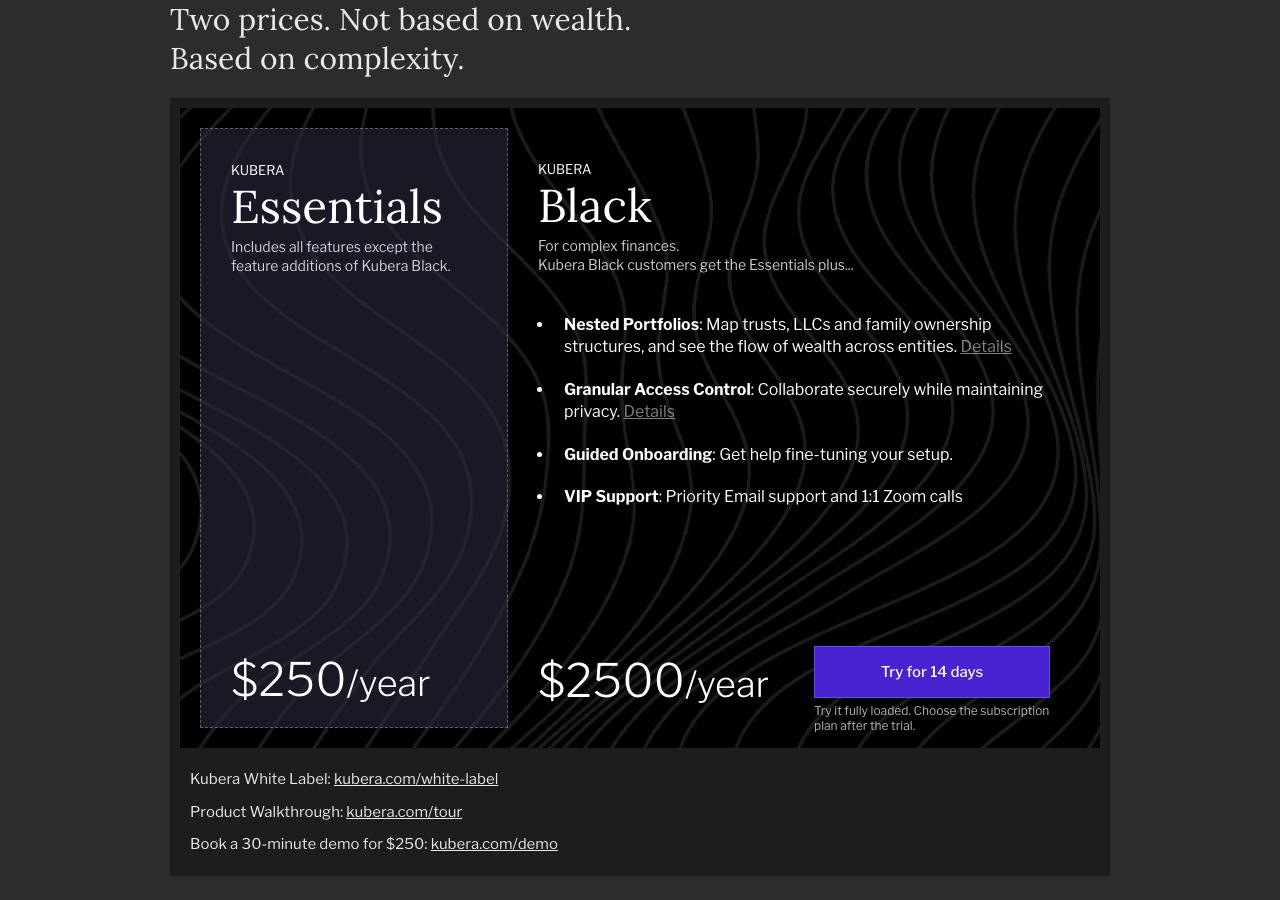
Kubera charges $250 a year. There is no monthly option to soften it, no $9.99 hook, no five-column grid to squint at. One price. And sitting above it, a second tier called Kubera Black at $2,500 a year.
Two round numbers, stacked. Kubera is not shy about either, and that is a deliberate signal about who they think is reading. So let's do the honest version: what $250 actually gets you, who it is plainly right for, and where the math stops working.
The price, plainly
Kubera Essentials is $250 a year as of August 2026, and includes everything except the handful of features reserved for Black. There is a 14-day free trial first, and you pick a plan after it ends. Black is $2,500 a year and is described on their own help page in three words: "For complex finances."
Divide $250 by twelve and you get roughly $21 a month. That is real money for software. It is also, notably, cheaper than one hour of almost any financial advisor, which is the comparison Kubera is quietly inviting you to make. Whether that comparison holds depends entirely on what you own.
What $250 buys
Breadth. That is the short answer, and it is not marketing fluff. Kubera's whole pitch is that the stuff which falls out of every other app has a row here.
From their own homepage, the coverage runs: banks and brokerages across "Thousands of institutions worldwide" through multiple aggregators, tickers from all major stock exchanges in the US, Canada, the UK, Europe, and Asia, and then the long tail. Crypto across major blockchains, exchanges, and wallets, including DeFi, NFTs, staking, and lending. LP positions pulled in through a Carta integration, with committed capital, capital calls, distributions, and IRR. Gold, real estate, vehicles, jewelry, watches. Their catch-all phrase for the rest is "Any ownable asset you can imagine."
On top of that inventory sits a set of features you do not find in consumer budgeting apps:
- Fast Forward, their scenario planning tool.
- Dead Man's Switch, which hands your records to a beneficiary if you stop checking in.
- Web Sync, a Chrome extension for pulling in balances from places no aggregator reaches.
- Multi-currency tracking, Proof of Wealth, and Club Benchmarks, an anonymous peer comparison.
- AI Appraiser for live price feeds, and an AI Advisor that plugs into ChatGPT, Claude, or Gemini.
Black adds four things on top, per their help article: "Nested Portfolios: Map trusts, LLCs and family ownership structures," "Granular Access Control: For enhanced collaboration and privacy," "Guided Onboarding," and "VIP Support: Email + 1:1 Zoom calls." Read that list again and you can see exactly who it is drawn for. Nobody builds nested trust mapping for a person with a 401k and a Roth.
The missing budgeting feature is a choice, not an oversight
This trips people up, so let's settle it. Kubera does not do budgeting. Not badly, not partially. It is not there, on purpose, and they say so on the front page in the voice of their own customer:
They describe themselves as "The balance sheet for those who manage their own wealth."
That is a real product decision and it deserves respect rather than a gotcha. A balance sheet answers one question well: what do I own, what do I owe, and what is the difference today. Bolting a spending tracker onto that muddies the answer. Plenty of tools have tried and ended up mediocre at both. Kubera picked a lane and built the whole car for it.
Just know what you are buying. If you sign up expecting to find out why last month cost $1,400 more than you thought, you will not find that answer here, and no setting will produce it.
Who Kubera is genuinely for
Someone whose money lives in more than five places, and at least one of those places is weird.
If you hold a rental with a mortgage, a slice of a startup that comes through Carta, a self-custodied wallet, some physical gold, a brokerage account, and a currency that is not dollars, you have a real problem: nothing you have tried can hold all of it at once. You have been maintaining a spreadsheet, and the spreadsheet is stale, and updating it is a Sunday-night chore you have started skipping. $250 to make that go away is not extravagant. It is cheap.
The same goes if your setup involves other people. Trusts, an LLC, a family office arrangement, an accountant who needs read access to one slice and not the rest. That is what Black exists for, and if you need it you already knew you needed it. Kubera also sells a White Label version to businesses starting at $300 a month, which tells you they know the professional side of that market is a different animal.
Here is the fair version of the recommendation: if the sentence "one place that holds everything I own and owe" describes something you genuinely cannot get anywhere else, Kubera is worth the money and you should stop comparison shopping.
The gap: a balance sheet does not tell you where the money went
Now the other reader. You looked at Kubera because you want your net worth in one place, your investments priced correctly, and a chart that goes up. Fair. But you also want to know what happened to your paycheck.
Those are two different jobs. A balance sheet is a photograph of a moment. Your spending is the film. Kubera does the photograph beautifully and does not attempt the film.
The usual fix is to run two apps, and it is worse than it sounds. You pay twice. You reconcile twice. Your checking account balance says one thing in one app and something slightly different in the other, and you spend twenty minutes finding out why. The simplicity you paid $250 for gets eaten by the second app you bolted on to cover the gap.
The cheaper end of that tradeoff
Pocketwatch was built for the second reader. Net worth, investments with live market prices, dividends, and budgeting sit in one app rather than two, in your browser on desktop or phone. Paid plans run $4 to $8 a month, and annual billing charges ten months, so the yearly cost lands somewhere between $40 and $96. Against $250, that is roughly two and a half to six times less, depending on which tier you land on. Budgeting plus manual cash and debt tracking are on the free tier.
Now the part vendor content usually skips. Pocketwatch does not match Kubera's breadth and is not trying to. No on-chain wallet syncing, no DeFi or NFT positions, no Carta feed for LP interests, no nested trust and LLC structures, no beneficiary handoff, no multi-currency ledger. If your net worth genuinely depends on those, the price difference is irrelevant, because the cheaper thing does not do the job.
The comparison only makes sense for a specific person: someone whose money is in a brokerage account, a retirement account, a couple of bank accounts, maybe a house and a car loan, who invests seriously enough to care that the share prices are current, and who also wants to see where the month went. For that person, $250 a year buys a lot of capability aimed somewhere else.
FAQ
How much does Kubera cost?
As of August 2026, $250 a year for Kubera Essentials, which includes every feature except the ones reserved for the higher tier. Kubera Black is $2,500 a year. There is a 14-day free trial, and you choose your plan when it ends. Their business White Label product starts at $300 a month.
Does Kubera have budgeting?
No, and that is intentional. Their own homepage copy puts it in the customer's mouth: "I don't want budgeting. I don't want an advisor pitch. I want a personal balance sheet..." They call themselves "The balance sheet for those who manage their own wealth." If tracking monthly spending is on your list, plan on a second tool or a different app.
What is Kubera Black?
The $2,500-a-year tier, described on their help site as being "For complex finances." It adds Nested Portfolios for mapping "trusts, LLCs and family ownership structures," granular access control for sharing, guided onboarding, and VIP support including 1:1 Zoom calls. If you do not own anything through a legal entity, this tier is not aimed at you.
Is there a cheaper net worth tracker that also does budgeting?
Yes, several, and the tradeoff is almost always asset breadth. You give up the exotic stuff (private LP positions, on-chain wallets, obscure institutions) and get spending and net worth under one roof for a fraction of the price. Pocketwatch sits in that category at $40 to $96 a year with live investment prices and dividend tracking included. Compare on the assets you actually hold, not on the feature list length.
How we wrote this
Every price and feature claim in this article was checked against Kubera's own site on the reviewed date above, and the screenshots are our own captures from that day. We are not neutral - this page lives on Pocketwatch's site - so we keep the rules simple: verify at the source, say who the other product is better for, and fix mistakes fast. Spotted one? Tell us.